Introduction
The medical device industry is often understood through the products it creates, from diagnostic equipment and surgical tools to imaging systems, implants, and digital health technologies. But the real story of this industry goes far deeper than the device itself. Behind every product is a network of people, processes, decisions, and partnerships that determine whether a medical innovation can truly improve care.
A medical device does not reach patients in a straight line. It begins with a clinical need, moves through research and development, passes through design, testing, manufacturing, and regulatory review, and then enters hospitals, clinics, and laboratories where it is used in real-world conditions. Even after launch, it continues to depend on service, maintenance, training, and feedback. In other words, the value of a medical device is created across an entire system, not at a single point in time.
This is why the medical device industry should be seen as an ecosystem rather than just a manufacturing sector. Its strength lies in the way innovation, regulation, quality, adoption, and long-term support work together to deliver better outcomes for patients and healthcare providers.
Join the Manufacturer Waitlist →
Key Takeaways
-
The medical device industry functions as a connected ecosystem, not as an isolated production chain.
-
A device creates value only when it is designed well, approved properly, adopted effectively, and supported over time.
-
Collaboration between clinical, technical, regulatory, and operational stakeholders is essential.
-
For India, ecosystem thinking is critical to strengthen healthcare delivery and domestic medical device growth.
Directory Launching Soon – Get Early Access →
Looking Beyond Products
The medical device industry is usually defined as the sector responsible for developing, manufacturing, and supplying technologies used in prevention, diagnosis, monitoring, treatment, and rehabilitation. While that definition is accurate, it still does not capture the full scale of the industry's impact.
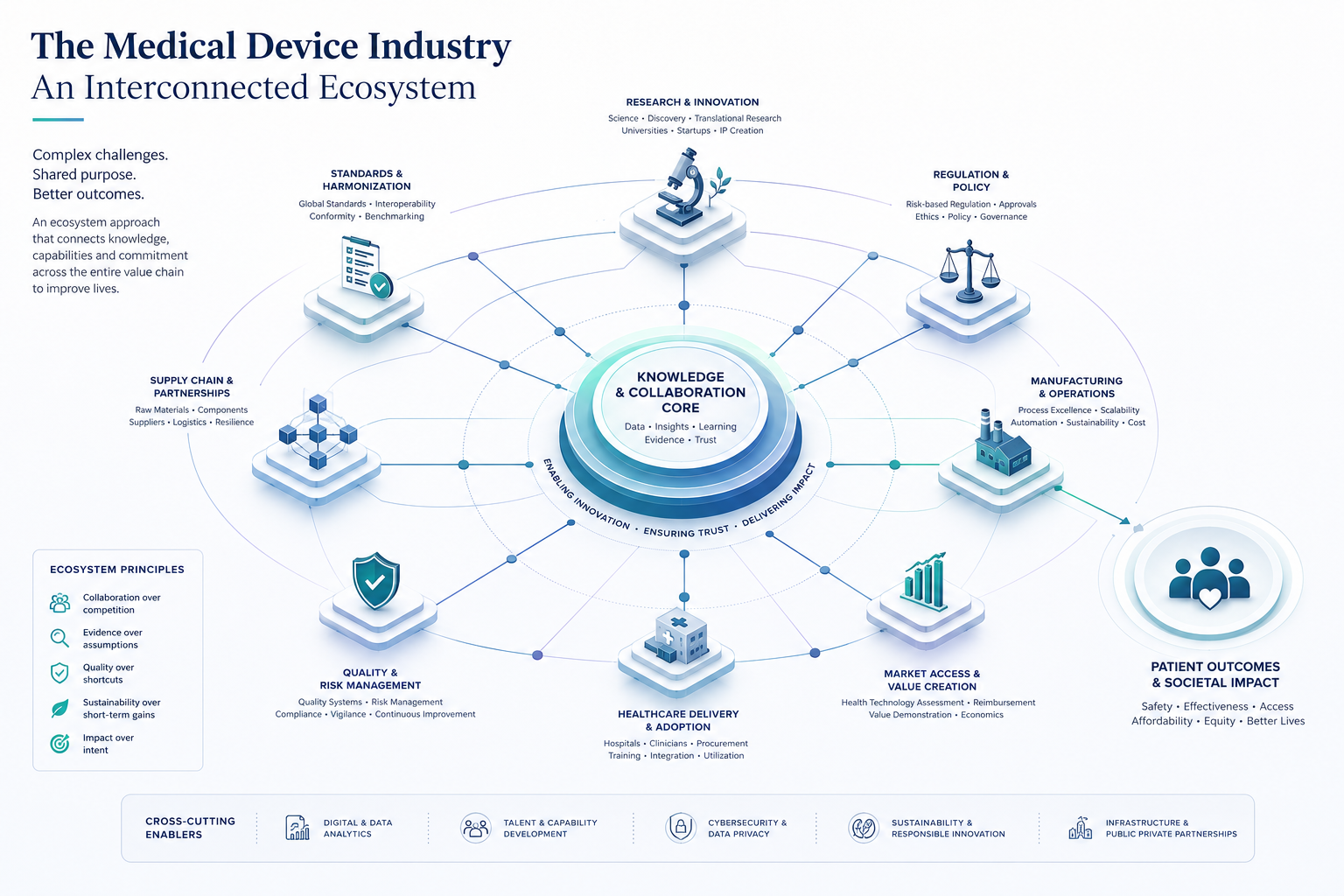
This sector sits at the intersection of healthcare, engineering, science, technology, and regulation. It includes everything from simple consumables and diagnostic kits to implantable devices, laboratory systems, imaging platforms, wearable technologies, digital health solutions, and AI-enabled tools. Each category serves a different purpose, but all of them share the same expectation: they must support safer, more effective, and more efficient care.
What truly distinguishes this industry is that success cannot be measured only by how many devices are manufactured or sold. A medical device creates real value only when it is trusted, adopted, used correctly, and maintained well throughout its lifecycle. That is why the medical device industry should be understood as a knowledge-driven system where innovation, quality, safety, and usability matter just as much as production.
Discover Innovation Showcase →
The Medical Device Ecosystem
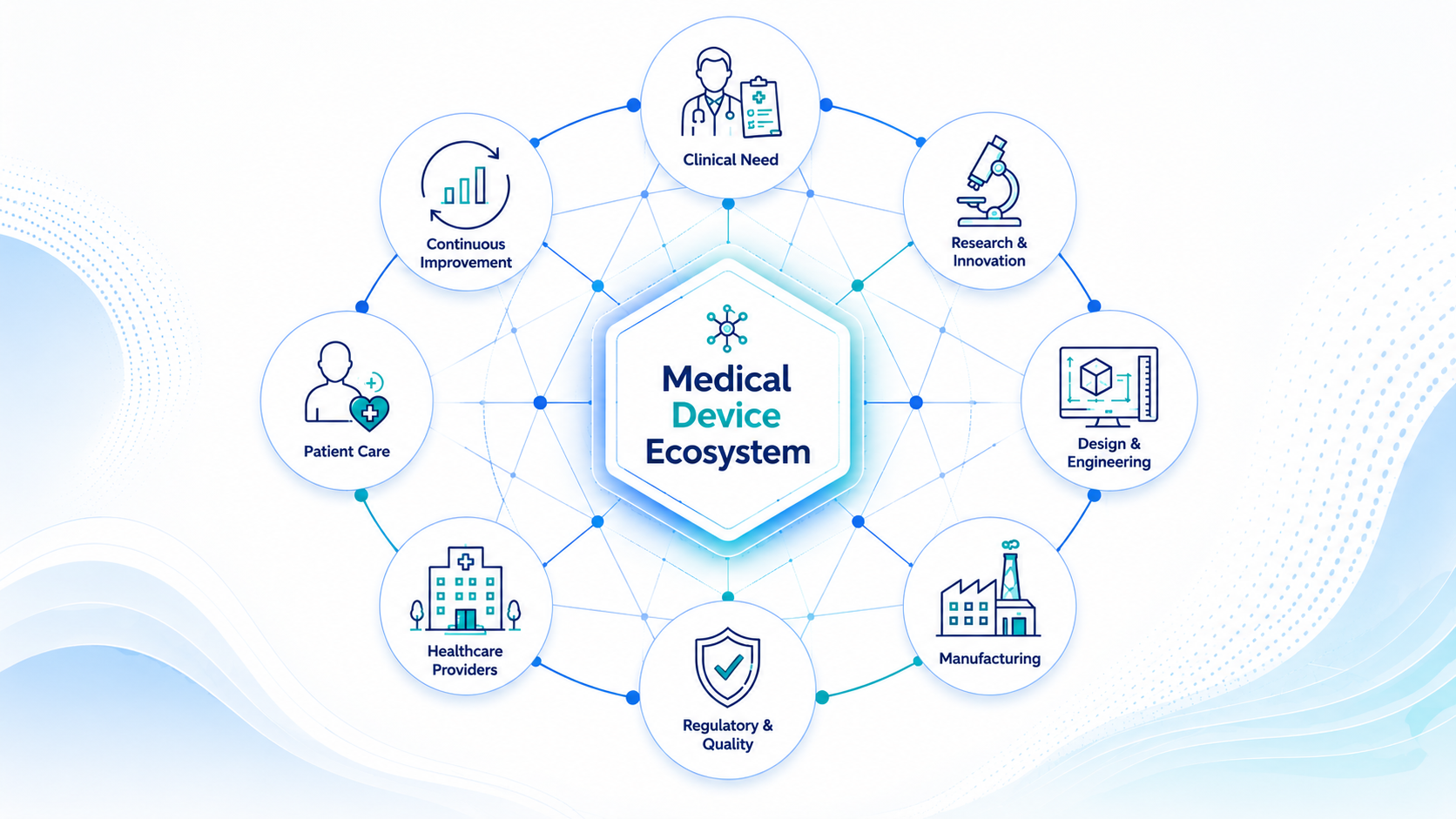
The medical device ecosystem brings together a wide range of stakeholders, each contributing to the journey from idea to patient care. Patients and healthcare professionals identify unmet needs through daily clinical experience. Researchers, scientists, designers, and engineers then work to turn those needs into practical solutions that can be tested and refined.
Manufacturers play a crucial role in converting those ideas into safe, reliable, and scalable products. Their work depends on robust quality systems, process control, and manufacturing discipline. At the same time, regulatory authorities, testing laboratories, and certification bodies help ensure that devices meet the required standards for safety, performance, and compliance before they enter the market.
The ecosystem does not end when the device is launched. Hospitals, clinicians, biomedical engineers, distributors, and service teams all contribute to installation, operation, maintenance, and performance monitoring. Their role is just as important as development because a medical device only delivers value when it works effectively in real healthcare settings. This is what makes the industry a true ecosystem: every stakeholder depends on the others, and every stage influences the next.
Be the First to Access Verified Listings →
From Clinical Need to Patient Care
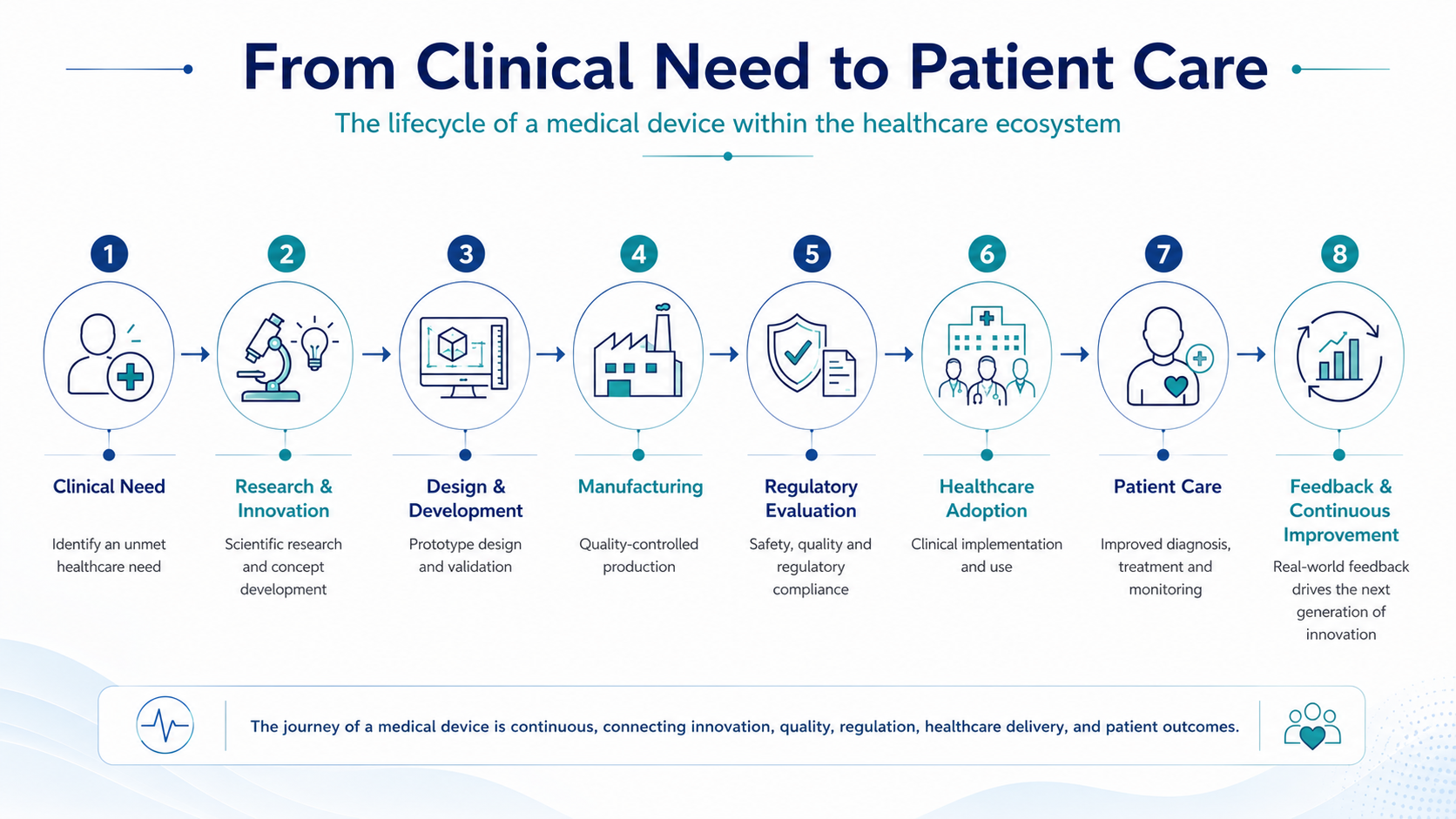
Every medical device starts with a problem that needs solving. It may be the need for earlier diagnosis, safer procedures, better monitoring, or more accessible treatment. The first step is always the same: understand the clinical challenge clearly and define what kind of solution is needed.
From there, researchers, engineers, and clinicians work together to explore possible ideas and develop prototypes. This stage often involves repeated testing, refinement, and validation before the concept is ready for the next phase. Once the design has been proven, manufacturers take over to produce the device consistently and at scale while maintaining quality and reliability.
Before the device reaches hospitals or clinics, it must also pass through regulatory evaluation and quality assessment. This is a crucial step because it helps confirm that the device meets established standards for safety, performance, and compliance. Regulatory review is not simply a formal requirement; it is part of building confidence among healthcare providers and patients.
Even after approval, the work is not finished. A medical device still needs proper installation, user training, routine maintenance, calibration, software updates, and performance monitoring. In many cases, feedback from clinicians, biomedical engineers, and users helps shape future improvements or new generations of the product. This ongoing cycle of need, development, use, and feedback is what gives the medical device industry its ecosystem character.
Why Ecosystem Thinking Matters
As healthcare becomes more complex, the medical device industry cannot rely on isolated effort. Progress depends on stronger coordination between innovators, manufacturers, regulators, healthcare institutions, and policymakers. The better these stakeholders work together, the more practical, reliable, and accessible medical technologies become.
This perspective is especially important in India, where healthcare needs are expanding and demand for high-quality, affordable medical technologies continues to grow. Ecosystem thinking helps align product development with clinical reality, manufacturing with quality expectations, and service with long-term healthcare use. It also supports stronger domestic capability by connecting research, policy, infrastructure, and industry more effectively.
In a fast-changing healthcare environment, this approach is no longer optional. Emerging areas such as digital health, connected devices, robotics, additive manufacturing, and data-driven care are making collaboration even more important. The future of the medical device industry will belong to organizations and professionals that can work across disciplines and think beyond product development alone.
Learn About India's Device Story →
Ready to Take the Next Step?
Whether you're a hospital preparing to source, a distributor exploring new opportunities, an investor evaluating the sector, or a manufacturer planning to enter the market, MIIMD is building the platform to connect you.
MIIMD Insight
The real strength of the medical device industry lies not only in the products it creates, but in the ecosystem that makes those products trusted, usable, and effective in healthcare.
Conclusion
The medical device industry is best understood as a connected ecosystem built on collaboration, accountability, and continuous improvement. From the first identification of a clinical need to the final stage of patient care, every step depends on the quality of relationships between different stakeholders.
When that ecosystem is strong, innovation becomes more practical, adoption becomes smoother, and healthcare outcomes become stronger. That is what gives the medical device industry its real value — not only the devices it produces, but the system that allows those devices to make a meaningful difference in people's lives.
